Race and start time
Confirm the exact race, meeting, distance and scheduled start.
 Rezilta
This learning centre explains the information shown on racecards, how common racing markets settle, and how form, draw, weight, distance, jockeys, trainers and track conditions can affect a race. It is educational content, not a promise of profit.

Build your knowledge from the racecard outward: identify the horse, understand the conditions, assess the evidence and only then compare the available price.

Learn what the race number, start time, horse number, draw, age, weight, jockey, trainer, gear and recent form mean.
Learn more
Understand the difference between a win bet, a place bet and an each-way bet, including how the place part is settled.
Learn moreUse decimal odds to understand potential return and implied probability. Compare prices before placing a bet.
Learn more
Review recent finishing positions, race class, distance, ground, pace and the strength of previous opposition.
Learn more
Consider current form, course record, horse-rider familiarity, stable confidence and changes in equipment or tactics.
Learn more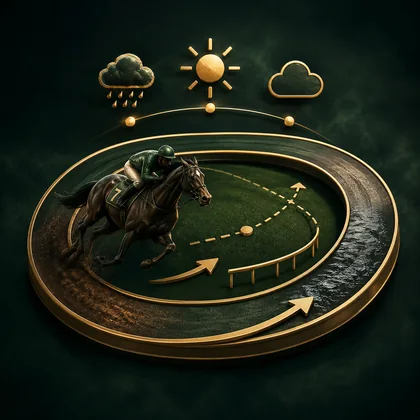
Assess surface, going, weather, draw bias, distance suitability, field size and likely pace shape.
Learn moreA racecard condenses a large amount of information. Read it in a consistent order rather than focusing only on the favourite.
Confirm the exact race, meeting, distance and scheduled start.
The horse number identifies the runner; the draw shows its starting stall where applicable.
Recent finishing positions require context: class, distance, ground and race shape matter.
Carried weight and age can affect performance differently depending on race type and conditions.
Current strike rate, course record and partnership history can add useful context.
Blinkers, cheekpieces, tongue ties and other gear changes can affect focus or performance.
Always check the bookmaker’s settlement rules because place terms, non-runner deductions and dead-heat calculations can vary.
The selection must finish first.
The selection must finish within the bookmaker’s stated place positions.
Two linked bets: one on the horse to win and one on the horse to place.
Predict the first two finishers in the correct order.
Covers both possible orders for two selected horses.
Predict the first three finishers in the correct order.
Check whether the horse has performed at a similar distance, surface and track configuration.
A recent win in weaker company may be less relevant than a close finish in a stronger race.
Front-runners, hold-up horses and prominent racers need a race shape that suits their style.
Look for repeated competitive performances rather than one isolated result.
Trainer switch, jockey booking, equipment, weight and layoff length may change expectations.
A horse can be the most likely winner but still offer poor value at a very short price.
The runner with the shortest available odds.
A runner offered at comparatively long odds.
The official description of the track surface condition.
The stall position allocated to a runner in relevant races.
A race where weights are allocated to equalise runners’ chances.
A race for horses that have not yet won.
A tipster’s strongest selection of the day.
A runner considered suitable for an each-way bet at the available odds.
A win bet requires the horse to finish first. A place bet wins when the horse finishes within the stated place positions.
It is two bets of equal stake: one to win and one to place. The place return uses the bookmaker’s advertised fraction of the win odds.
The favourite usually has the highest market-implied probability, but it can still lose and may not offer value at the available price.
It usually lists recent finishing positions, but the meaning must be interpreted with race class, distance, ground and dates.
Some tracks and distances favour certain starting positions because of bends, rail placement, pace and field size.
Settlement depends on the bookmaker and market. Stakes may be refunded, and deductions may apply to remaining runners.
Open the latest racecards, review today’s tips and compare horse-racing odds using the same structured process.

Best for: High odds

Best for: Cryptocurrencies betting

Best for: Crypto Sports Betting
Affiliate links may generate commission for Rezilta. Compare terms, eligibility and local availability before registering.

Get faster access to predictions, racecards, results and lotto draws from your home screen.
Install Rezilta on iPhone or iPad
Tap Share, choose Add to Home Screen, then tap Add.
